 2017, Vol. 49
引用本文 |


2. 四川大学 建筑与环境学院,四川 成都 610065
2. School of Architecture and Environment,Sichuan Univ.,Chengdu 610065,China
对于长期承受低幅值循环载荷作用的金属结构和部件,因材料的微观各向异性和金属加工过程中形成的孔洞和夹杂等因素,导致材料受外载荷作用时,内部应变分布不均,使得结构在幅值低于其静强度的循环载荷作用下也会因局部塑性累积发生疲劳失效[1–2]。因此,在强度设计中材料的疲劳强度参数尤为重要。然而,通过传统疲劳试验方式确定材料的疲劳强度参数耗时费力。一种基于经验式的基于固有耗散能理论的方法被用于快速估测材料在低周疲劳[3]、高周疲劳[4–5]及超高周疲劳[6]范畴内的疲劳损伤。金属材料在受到外载荷作用时存在机械能向固有耗散能的转换,固有耗散能的累积会引起材料温度的升高。温升大小受载荷条件的影响之外还与周围环境与材料之间的热传导及材料的热边界条件等因素有关,不是材料的本质响应[7],而固有耗散能是一个独立于材料外形尺寸、热边界条件以及其他外部条件的量,是材料的本质响应。
作者利用电磁谐振疲劳试验机,扫描电子显微镜(SEM)和红外热像仪,从微观角度研究了Q345钢在高周疲劳载荷作用下材料的裂纹萌生和扩展以及疲劳载荷作用下试样表面温度场变化。在热力学框架内,建立一个用于描述Q345钢在有限寿命循环载荷作用下材料的固有热耗散能的热力学模型。通过固有耗散能试验能快速确定Q345钢在高周疲劳范畴内的疲劳极限,并讨论该疲劳极限在热力学框架内的意义。
1 材料和试验本试验所用的材料为20 mm厚热轧低碳钢Q345板材,材料的化学成分构成为C,0.16%;Si,0.35%;Mn,1.34%;S,0.011%;P,0.022%;其余为Fe元素。图1为该材料的微观结构的SEM图。
图1中材料为铁素体和珠光体双相结构低碳钢,双相在轧制方向呈平行带状分布。疲劳试样所受载荷方向与轧制方向平行,试样表面经机械抛光至镜面状态。表1给出了该微观结构材料的力学性能参数。
 |
| 图1 Q345微观结构 Fig. 1 Microstructure of Q345 |
| 表1 Q345力学性能参数 Tab. 1 Mechanical properties of Q345 |
 |
疲劳试验利用电磁谐振高频疲劳试验机分5个应力水平在室温下完成,谐振频率为140 Hz,正弦式循环载荷应力比为R=–1。当循环载荷作用次数达到107周次时,试样仍未发生疲劳失效,则试验停止。在疲劳试验过程中,利用红外热像仪记录试样表面温度场的变化。
2 试验结果 2.1 疲劳寿命试验结果图2为Q345钢高频疲劳寿命试验结果。由图2可知:材料在140 Hz正弦式循环载荷作用下的疲劳寿命随疲劳强度的降低呈逐渐上升趋势。在高疲劳强度下,材料的疲劳寿命分散程度较低,随着疲劳强度的降低,材料的疲劳寿命分散程度逐渐上升。利用3参数方法得到材料在10%、50%及90%3种不同失效概率下的P-S-N曲线[8]。当失效概率为50%时,使得材料疲劳寿命达到107周次时的疲劳强度
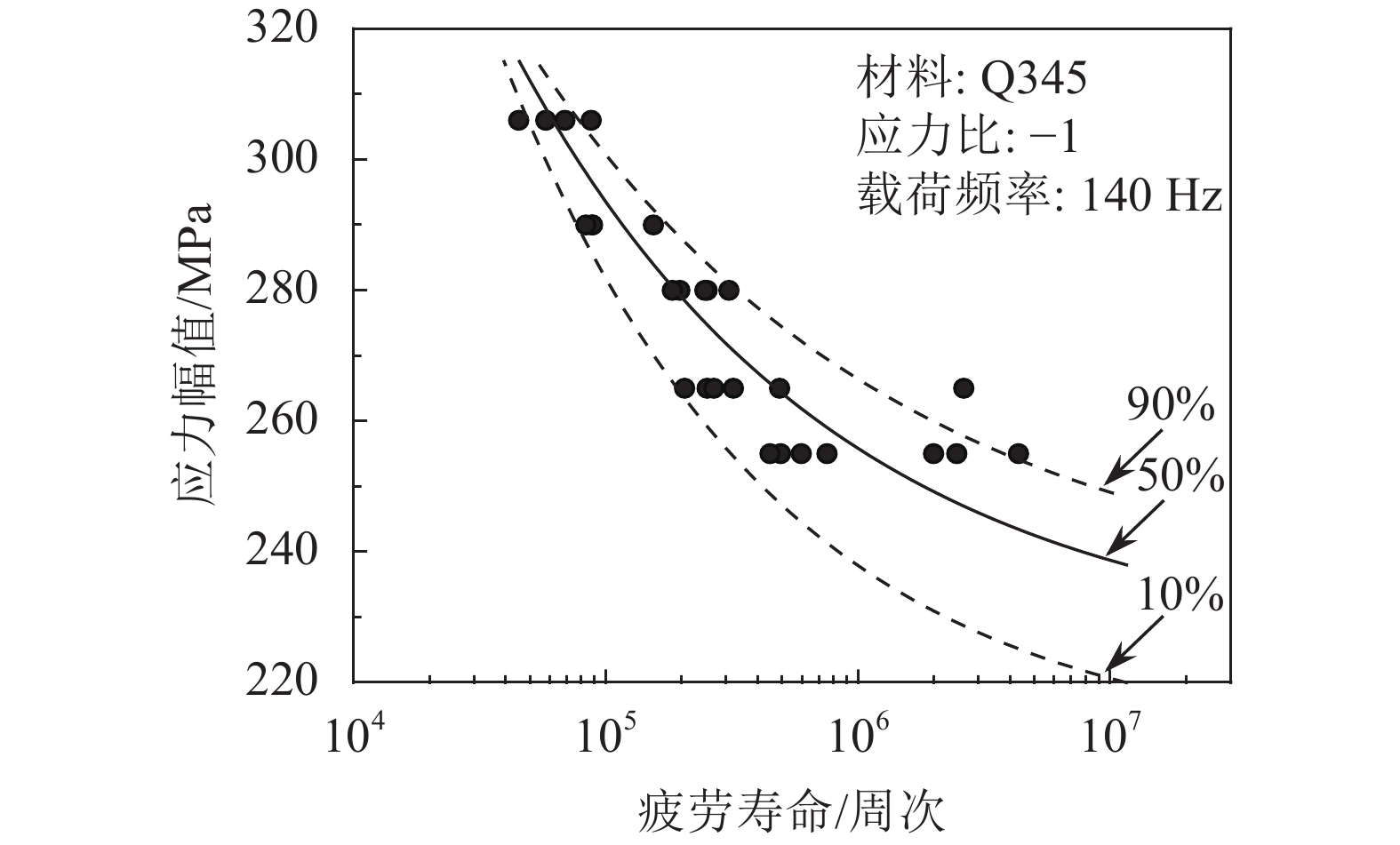 |
| 图2 Q345钢P-S-N曲线 Fig. 2 P-S-N curves of Q345 |
2.2 疲劳试样表面温升试验结果
图3(a)为不同幅值循环载荷作用下试样表面温度随循环载荷周次变化数据。由图3(a)可知:温升曲线大致可分为3个阶段[3–4]。试样表面温度在初始阶段随循环载荷作用次数的增加快速升高;之后进入平衡阶段,由于试样表面与周围环境之间的热交换达到平衡,该阶段内试样表面温度趋于稳定,同一横截面处,试样表面温度大致相同;这种平衡最终因宏观裂纹的出现而终止,裂纹断面之间相互挤压和摩擦,使得试样表面温度会再次骤升,且在裂纹尖端处为温度场奇点,温度最高。
温度平衡阶段试样表面温升∆T和载荷条件有关,当频率相同时,主要受载荷幅值Σa的影响。图3(b)给出了140 Hz循环载荷作用下Q345钢疲劳试样在平衡阶段的表面温升与循环载荷幅值之间的关系。由图3(b)可知:当Σa<230 MPa时,试样表面温升约为0。在该载荷条件下,材料具有无限寿命。随着载荷进一步升高,两者之间的关系呈非线性。
 |
| 图3 温升试验结果 Fig. 3 Test results of temperature variation |
3 疲劳裂纹萌生及扩展机理
利用扫描电子显微镜对疲劳失效后的试样断面进行显微观察分析,如图4所示。图4(a)为本次试验中典型的断面形貌SEM像,由图4(a)可知,Q345钢的高周疲劳裂纹萌生位置均位于试样表面。对于铁素体–珠光体双相结构材料Q345,材料微观结构的弹性刚度不同,铁素体结构较薄弱,约占材料总体积的70%。当材料受到宏观弹性范围内的循环载荷作用时,材料内部双相结构的力学响应不同,微观结构的不均匀分布导致微观应变分布的不均匀,铁素体结构先于珠光体结构进入非弹性变形阶段。随着载荷幅值和循环周次的增加,由微观结构差异性引起的局部应变梯度逐渐累积,直至材料失去自洽能力,如图4(b)所示,薄弱相铁素体晶粒内部出现裂纹或从较硬的珠光体晶粒上分离,微观裂纹开始萌生。
随着循环载荷作用周次的增加,萌生于不同位点处的微观裂纹逐渐向周围扩展。当裂纹尖端塑性区尺寸小于晶粒尺寸时,裂纹主要以穿晶断裂向前扩展。当裂纹尖端塑性区尺寸增长至大于晶粒尺寸时,则裂纹倾向于沿晶界向前扩展。此时,晶界为裂纹扩展的低阻力路径,在恒定的屈服应力下,其断裂韧性小于穿晶断裂时的断裂韧性。
如图4(c)所示,裂纹在向前扩展时遇到珠光体晶粒时,其方向会发生偏转使得裂纹扩展路径更加曲折[9–10]。此外,当裂纹尖端遇到珠光体结构时,若裂纹尖端应力强度因子较小,裂纹易被珠光体结构捕捉而停止扩展,如图4(d)所示。
 |
| 图4 疲劳失效后的试样扫描电镜图 Fig. 4 SEM photos of failed specimens |
4 Q345固有耗散能热力学模型
疲劳试验过程中材料的自热现象与材料内部塑性变形单元的耗散能[6]有关,对于Q345钢,由于铁素体结构的体积分数约为70%,且先于珠光体结构进入塑性变形阶段。因此,铁素体结构作为非弹性应变能耗散的活跃位点,其非弹性变形是导致材料宏观温升的主要原因。材料非弹性变形的活跃单元的体积随着循环载荷幅值的变化而变化,使得载荷作用的初始阶段材料表面温度变化率μ和平衡阶段的温升∆T均与循环载荷幅值有关。
当作用于疲劳试样的循环载荷为无限寿命载荷时,疲劳试样表面的温度变化不明显[11–12]。在传统疲劳试验中,可将材料的疲劳极限看作是不会引起疲劳试样表面温度变化的最大循环作用力。因此,金属材料的疲劳极限可以利用测温设备,观测不同幅值载荷下试样表面温度变化,并将试样表面温度稳定时的温度变化量外推至临界零点来确定[13]。另外,循环载荷作用下疲劳试样表面的初始阶段温度变化率μ也可被当作独立的参数用于直接估测材料的疲劳强度[14]。图5为不同载荷条件下初始阶段试样表面温度变化率,由图5可知,将试验结果外推至相对零点可以得到Q345钢在140 Hz高频载荷作用下的有限寿命疲劳强度最低值为Σt=236.07 MPa,略低于疲劳试验所确定的疲劳寿命为107周次时的疲劳强度
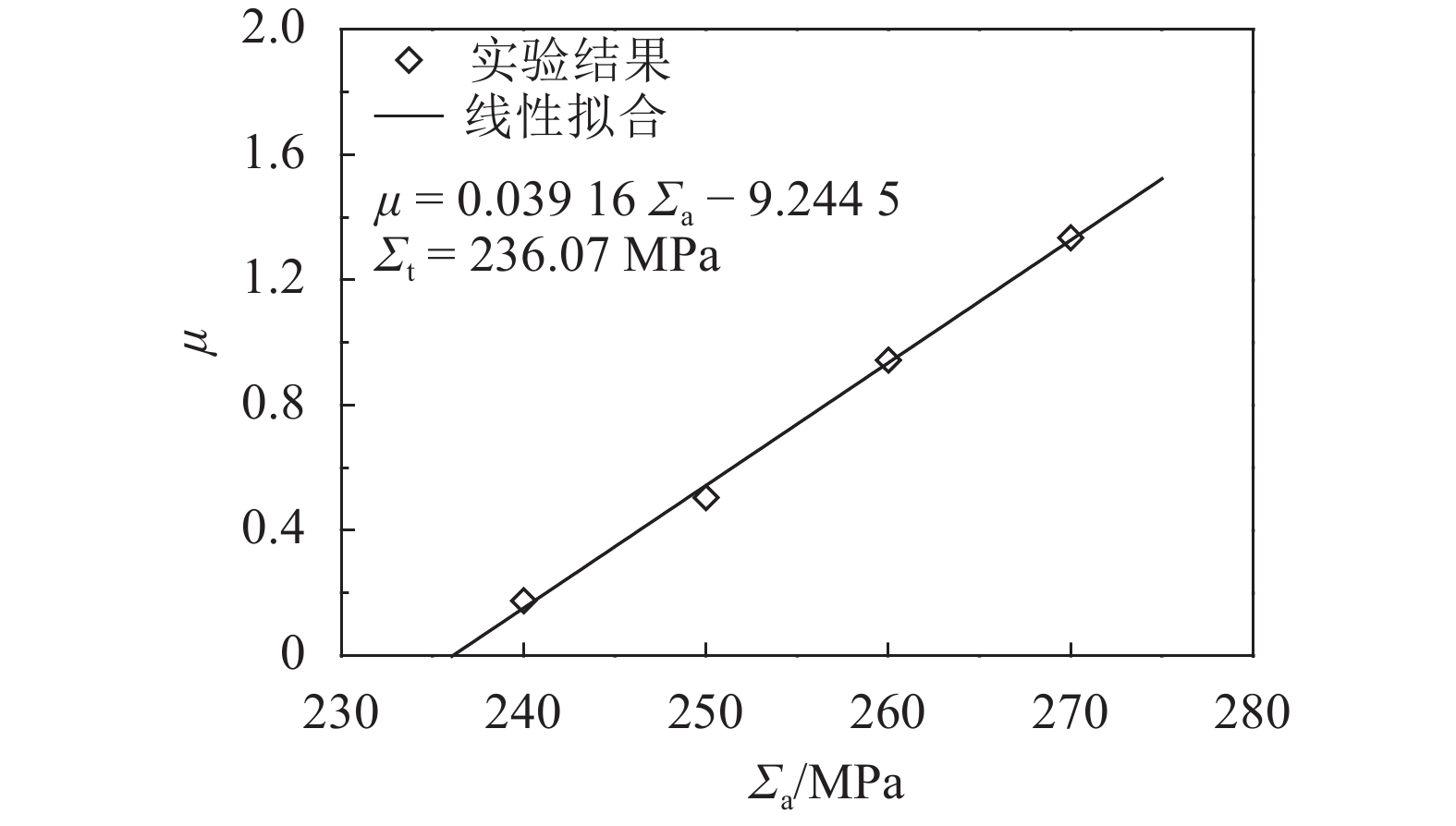 |
| 图5 不同载荷条件下初始阶段温度变化率 Fig. 5 Temperature variation rate in the initiation stage |
假设材料为各向同性,其力学和热学特性不随时间和材料内部空间位置的变化而改变。当材料受到循环载荷作用时,基于能量平衡理论[15–16]有:
| $\dot \theta + \frac{\theta }{{{\tau _{\rm eq}}}} = \frac{{D \cdot f}}{{\rho {C_{\rm p}}}}$ | (1) |
式中,
| $\theta = \overline \theta \cdot {{\rm e}^{ - t/{\tau _{\rm eq}}}}$ | (2) |
式中,
在体积V上,假设材料耗散能活跃单元的弹性极限为
| ${\varepsilon } = {{\varepsilon }^{\rm e}} + {{\varepsilon }^{{\rm{in}}}}$ | (3) |
其中发生非弹性变形的活跃单元的体积Vin占总体的体积分数fin=Vin/V。根据线性随动硬化理论,活跃单元处的背应力张量
| ${\dot{{s}}^{\rm in}} = \frac{2}{3}C{\dot{\varepsilon }^{\rm in}}$ | (4) |
| ${\dot{\varepsilon }^{\rm in}}{\rm{ = }}{\dot \lambda _{\rm in}}\frac{{\partial f}}{{\partial {s}}}$ | (5) |
式(4)中,C为材料的硬化系数;f为屈服面;
| ${\dot \lambda _{\rm in}} = \frac{{H(f)}}{h}\frac{{\partial f}}{{\partial {\sigma }}}:\dot{\varSigma }$ | (6) |
式中:H(f)为赫维赛德阶跃函数(Heaviside step function);硬化模量
| $\beta = 2(4 - 5\nu )$ | (7) |
此时,活跃单元处的微观作用力可由宏观作用力Σ求得[18]:
| ${\sigma } = {\varSigma } - 2\mu (1 - \beta ){{\varepsilon }^{\rm in}}$ | (8) |
材料在循环载荷作用下因内部非弹性变形能而引发的耗散能密度可由式(9)求出:
| ${d_1} = {f_{\rm in}}({\sigma } - {s^{\rm in}}):{\dot{\varepsilon }^{\rm in}}$ | (9) |
每一载荷循环的耗散能密度DΣ等于材料内所有发生非弹性变形单元的非弹性变形能的总和:
| ${D_\varSigma } = \int_t^{t + \frac{1}{{{f_r}}}} {{f_{\rm in}}} \dot \lambda [{ \sigma } - {{ s} ^{\rm in}}]:\frac{{\partial f}}{{\partial {\sigma } }}{\rm d}t$ | (10) |
对式(10)求积分可得:
| ${D_\varSigma } = \frac{{4{f_{\rm in}}\sigma _{\rm y}^{\rm f}}}{h}\left\langle {\varSigma - \sigma _{\rm y}^{\rm f}} \right\rangle $ | (11) |
式中,
材料在受到幅值为Σa的宏观作用力时,其耗散能密度为:
| $D = \int_0^{{\varSigma _{\rm a}}} {V{D_\varSigma }} \frac{{{\rm d}\lambda }}{{{\rm d}\varSigma }}{\rm d}\varSigma $ | (12) |
对于受单向循环载荷Σa的光滑试样,活性位点刚度
对式(12)积分得:
| $D = \frac{{4m\varSigma _{\rm a}^2}}{{h(m + 1)(m + 2)}}{(\frac{{{\varSigma _{\rm a}}}}{{{s_0}}})^m}$ | (13) |
此时,材料在循环载荷作用下的热耗散量是一个仅与循环载荷Σa有关的量。
在固有耗散能试验中,每一载荷循环内材料的固有耗散能D是一个反应材料疲劳性能的本质参量,图6给出了Q345在140 Hz循环载荷作用下固有耗散能D的试验值与模型曲线。由图6可知,该模型能较好描述材料在140 Hz循环载荷作用下的固有耗散能。
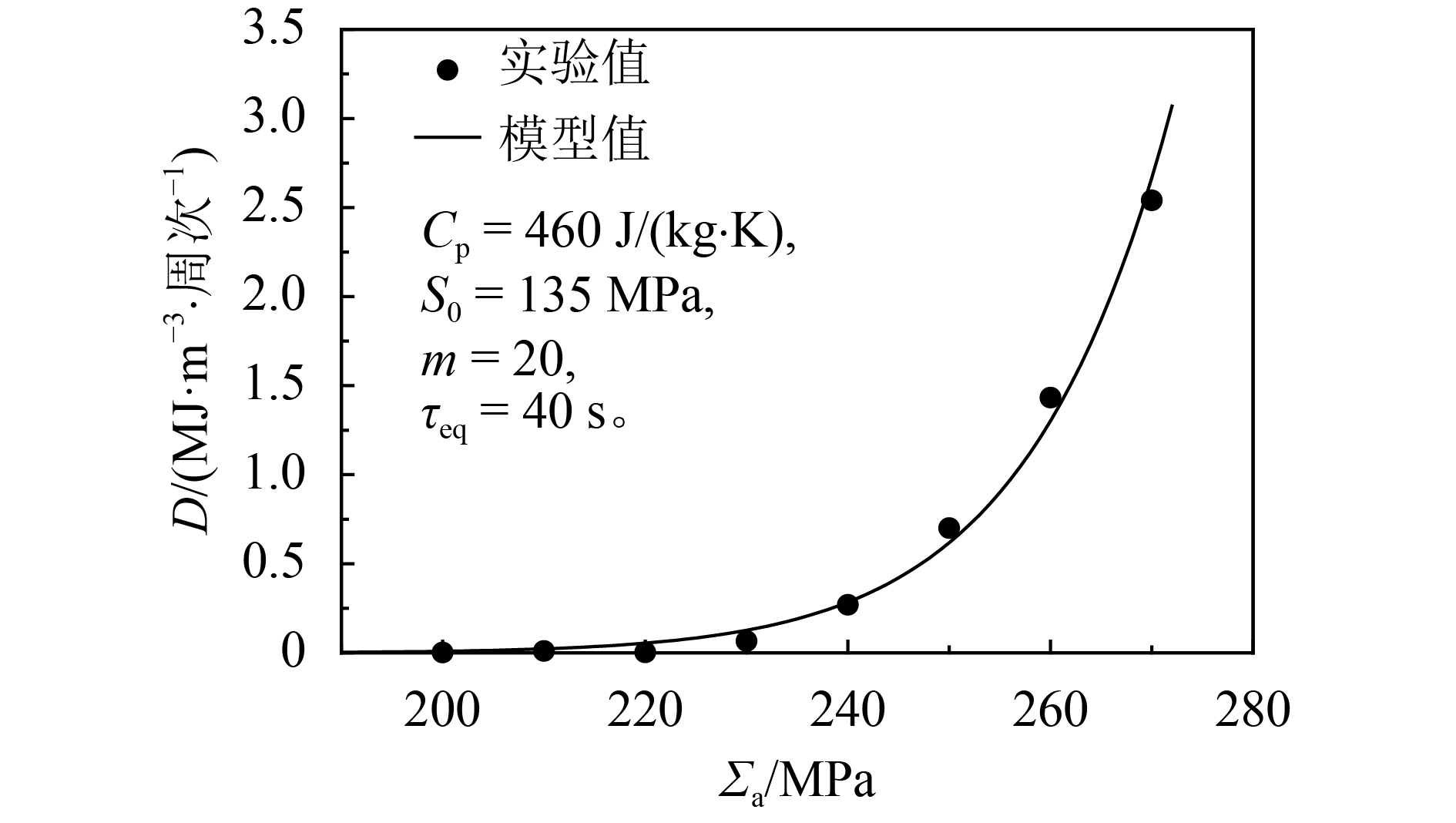 |
| 图6 试验值与模型曲线 Fig. 6 Test results and model curve |
5 结 论
基于传统疲劳试验和疲劳失效过程中试样表面的温度变化研究了低碳钢Q345在140 Hz循环载荷作用下的高周疲劳裂纹萌生和扩展机理,得到3种不同失效概率下Q345钢的P-S-N曲线,主要结论如下:
1)循环载荷作用下,Q345钢的疲劳裂纹均萌生于试样表面铁素体晶粒或铁素体和珠光体的晶界处,之后沿铁素体内部或晶界向前扩展,裂纹在扩展过程中遇珠光体后会转向或停止扩展。
2)通过试样表面在循环载荷作用下初始阶段的温度变化率,可以快速得到Q345钢在140 Hz循环载荷作用下的高周疲劳极限。
3)在热力学框架内建立一个通过计算非弹性变形耗散能来预测材料固有耗散能的模型,探讨了疲劳极限在该模型中的实际意义,模型值和试验结果符合较好。
| [1] |
Pérez-Mora R, Palin-Luc T, Bathias C. Very high cycle fatigue of a high strength steel under sea water corrosion:A strong corrosion and mechanical damage coupling[J]. International Journal of Fatigue, 2015, 74: 156-165. DOI:10.1016/j.ijfatigue.2015.01.004 |
| [2] |
Wang Q Y, Bathias C, Kawagoishi N. Effect of inclusion on subsurface crack initiation and gigacycle fatigue strength[J]. International Journal of Fatigue, 2002, 24(12): 1269-1274. DOI:10.1016/S0142-1123(02)00037-3 |
| [3] |
Crupi V, Chiofalo G, Guglielmino E. Infrared investigations for the analysis of low cycle fatigue processes in carbon steels[J]. Journal of Mechanical Engineering Science, 2011, 225(4): 833-842. DOI:10.1243/09544062JMES2324 |
| [4] |
Meneghetti G. Analysis of the fatigue strength of a stainless steel based on the energy dissipation[J]. International Journal of Fatigue, 2007, 29(1): 81-94. DOI:10.1016/j.ijfatigue.2006.02.043 |
| [5] |
Fan J, Guo X, Wu C. A new application of the infrared thermography for fatigue evaluation and damage assessment[J]. International Journal of Fatigue, 2012, 44: 1-7. DOI:10.1016/j.ijfatigue.2012.06.003 |
| [6] |
Huang Z Y, Wang Q Y, Wagner D. A very high cycle fatigue thermal dissipation investigation for titanium alloy TC4[J]. Materials Science & Engineering A, 2014, 600: 153-158. |
| [7] |
Chrysochoos A, Berthel B, Latourte F. Local energy approach to steel fatigue[J]. Strain, 2010, 44(4): 327-334. |
| [8] |
Liu H Q, Wang Q Y, Huang Z Y. High-cycle fatigue and thermal dissipation investigations for low carbon steel Q345[J]. Key Engineering Materials, 2016, 664: 305-313. |
| [9] |
Toribio J, González B, Matos J C. Fatigue and fracture paths in cold drawn pearlitic steel[J]. Engineering Fracture Mechanics, 2010, 77(11): 2024-2032. DOI:10.1016/j.engfracmech.2010.02.003 |
| [10] |
Korda A A, Miyashita Y, Mutoh Y. Fatigue crack growth behavior in ferritic–pearlitic steels with networked and distributed pearlite structures[J]. International Journal of Fatigue, 2007, 29(6): 1140-1148. DOI:10.1016/j.ijfatigue.2006.09.008 |
| [11] |
Fargione G, Geraci A, Rosa G L. Rapid determination of the fatigue curve by the thermographic method[J]. International Journal of Fatigue, 2002, 24(1): 11-19. DOI:10.1016/S0142-1123(01)00107-4 |
| [12] |
Rosa G L, Risitano A. Thermographic methodology for rapid determination of the fatigue limit of materials and mechanical components[J]. International Journal of Fatigue, 2000, 22(1): 65-73. DOI:10.1016/S0142-1123(99)00088-2 |
| [13] |
Fan J L, Guo X L, Wu C W. Research on fatigue behavior evaluation and fatigue fracture mechanisms of cruciform welded joints[J]. Materials Science & Engineering A, 2011, 528(29/30): 8417-8427. |
| [14] |
Zhang L, Liu X S, Wu S H. Rapid determination of fatigue life based on temperature evolution[J]. International Journal of Fatigue, 2013, 54(1): 1-6. |
| [15] |
Louche H, Chrysochoos A. Thermal and dissipative effects accompanying Lüders band propagation[J]. Materials Science & Engineering A, 2001, 307(1): 15-22. |
| [16] |
Boulanger T, Chrysochoos A, Mabru C. Calorimetric analysis of dissipative and thermoelastic effects associated with the fatigue behavior of steels[J]. International Journal of Fatigue, 2004, 26(3): 221-229. DOI:10.1016/S0142-1123(03)00171-3 |
| [17] |
Lemaitre J,Chaboche J L.Mechanics of solid materials[M].London: Cambridge University Press,1994.
|
| [18] |
Berveiller M, Zaoui A. An extension of the self-consistent scheme to plastically-flowing polycrystals[J]. Journal of the Mechanics & Physics of Solids, 1978, 26(5): 325-344. |